|
|
|
|
China - Xi'an & Chengdu |

|
During the Easter holiday of 2026, I am in Xi’an once again, returning after just four short years. But this time, the purpose was different. I wasn’t here for work but came to bring Royceton to witness the living ancient capital of China, to let him feel the history where early Chinese dynasties once rose, and to stand at the very beginning of the Silk Road before life carries us onward to North America and Europe. |
 This trip, I added a new destination — Mount Hua, one of China’s most legendary peaks. The views were absolutely breathtaking and had us in awe. |
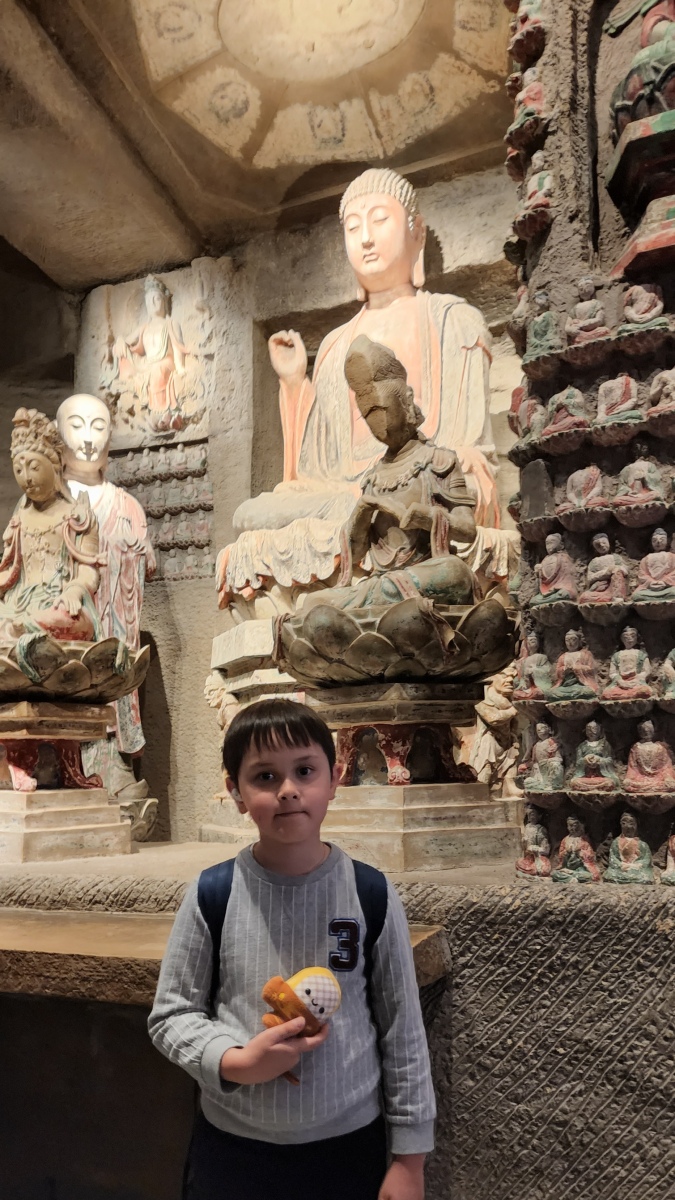 Instead of heading to Luoyang, we wandered through the Shaanxi History Museum, exploring ancient national treasures including this 钟山石窟 Zhongshan Grotto. |
 The jewel of Xi’an is, of course, the Terracotta Warriors Museum. We explored the site on our own this time, moving at our own pace, letting each hall and each warrior reveal itself slowly. With that freedom, we even had enough time to visit Mount Li, adding another layer of history and landscape to the trip. |
 Another gem of Xi’an is the Giant Wild Goose Pagoda (大雁塔), the home and translation site of the great monk Xuanzang, who journeyed to India in the Tang dynasty to bring back Buddhist scriptures. |
 The Xi’an City Wall is a fortress that has stood since the Tang dynasty. Walking along its broad stone path, we could almost feel the centuries layered beneath each step — emperors, merchants, soldiers, and now us, adding our own small moment to its long story. |
 I was born at the 芒种 season when grains ripen and the summer heat begins to gather. Here so I am standing next to this ceremonial drum at the Drum Tower. |
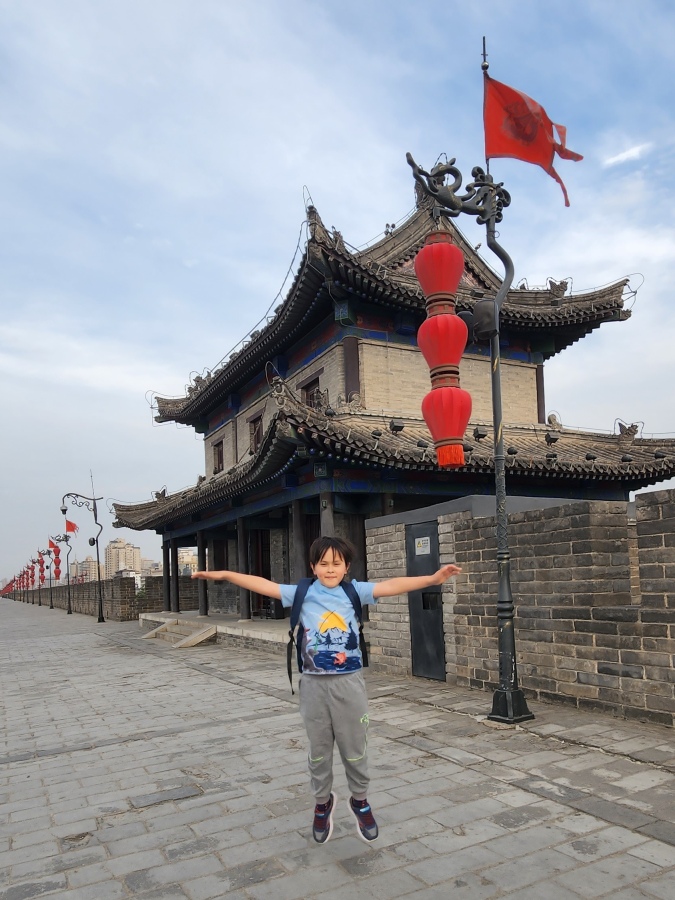 Walking along the Xi’an City Wall, I wished Royceton could experience the joy of riding a bicycle on its ancient stones. But children under twelve aren’t allowed to ride here. |
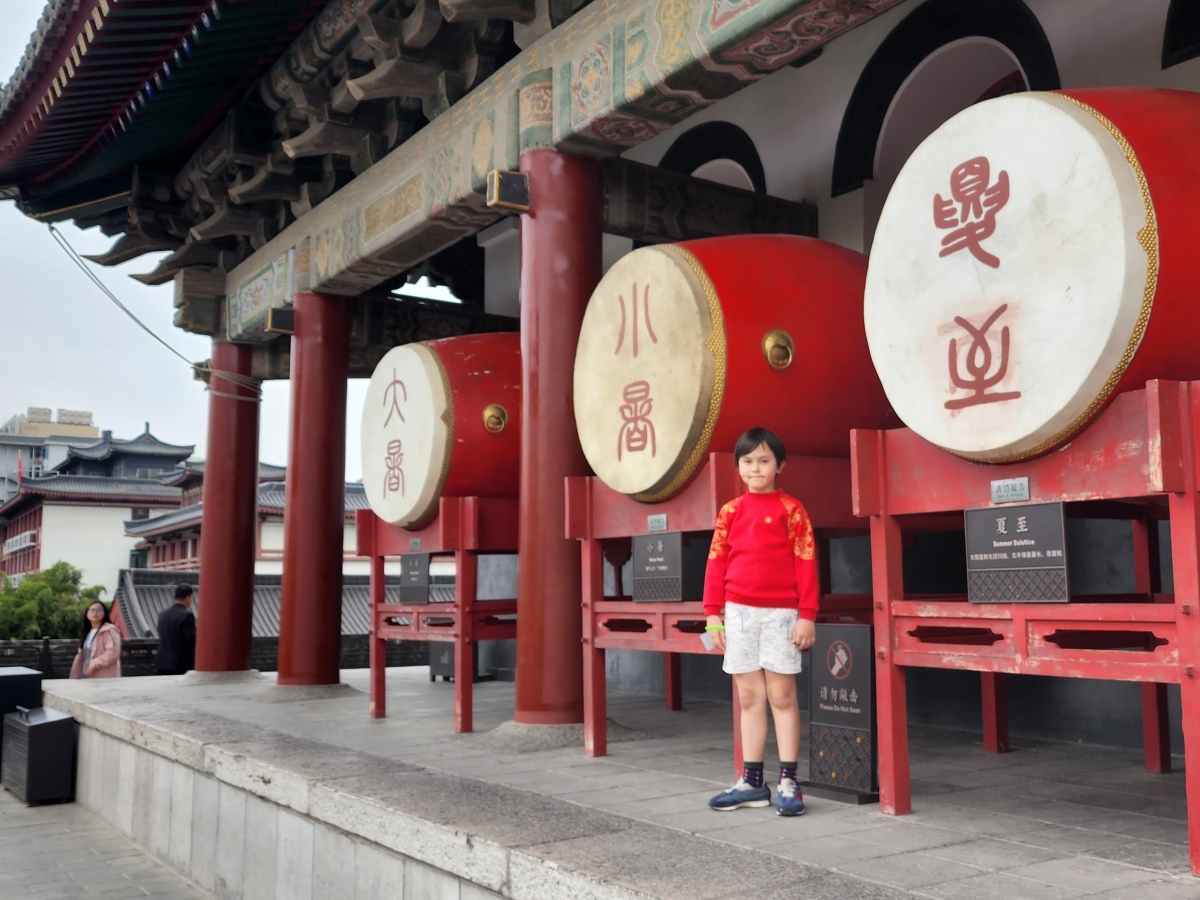 Royceton, on the other hand, was born just after summer solstice, when daylight is at its longest and the world feels wide and full of possibility. |
 On the city wall, we are suspended between the old city within and the new city beyond. In a way, the slower pace made the 2 hours walk more memorable. |
 From the adjacent mall, we had a night view of the Bell Tower which illuminated like a lantern in the heart of the city, while the Drum Tower is not too far from the sight. |
 It took us two hours to stroll from the South Gate Yongning Gate (永宁门) all the way to the West Gate Anding Gate (安定门). From there, we stepped back into the old city through the gate itself. |
 Local legend says that during the Ming dynasty, a powerful earthquake shook the ancient capital of Xi’an. The emperor, alarmed by the tremors, believed they were caused by a dragon stirring beneath the city. |
.jpg) I had a discussion with a friend on the interpretation of 省心. Yet, according to historical descriptions of the Great Mosque, 省心楼 is the mosque’s minaret, calling believers for prayers. So the words 省心楼 means the Tower of Self‑Reflection. |
 Fearing that the creature would bring further chaos, he ordered the Bell Tower to be moved to the exact center of the city. A symbolic act to pin down the dragon and restore harmony to the land. |
 Compared to my last visit, the Great Mosque has added four new plaques with Chinese calligraphy. Their presence feels intentional — a quiet way of reaffirming the mosque’s long history in Xi’an and its place within Chinese culture. |
 We ended up eating on Huimin Street almost every day. It became our routine without us even noticing. Royceton always went straight for his favourites grilled meat skewers, lamb, and a big bowl of biang biang noodles. |
 The Hui community in Xi’an has been present since the Tang dynasty, but the neighborhood was reorganized in the Ming and Qing. The area was modernized in the 20th century. The current “Huimin Street” commercial layout is mostly from the 1980s–2000s tourism development. |
 Here Royceton tore a dry dough by hand, piece by piece — just like the old desert‑caravan style of eating. After the dough is fully shredded, the chef adds broth, meat, and vegetables, and transforms it into a steaming bowl of Yangrou Paomo 羊肉泡沫. |
 We mainly ate at 老安家, among the old restaurants in the area whose origins trace back to the Qing dynasty. In a city as old as Xi’an, this establishment feels “young”. So the eateries here are for us to taste the intangible asset and experience the living tradition. |
 At the Giant Wild Goose Pagoda (大雁塔), we stood before the ancient verses carved with Sanskrit and the Chinese translation of the Prajñāpāramitā Sūtra (《菠萝蜜多经》). |
.jpg) In that quiet moment, I found myself wishing for something simple and sincere: that we all stay healthy, and that our transition into the next stage of life unfolds smoothly, with clarity and peace in our hearts. |
 |
 |
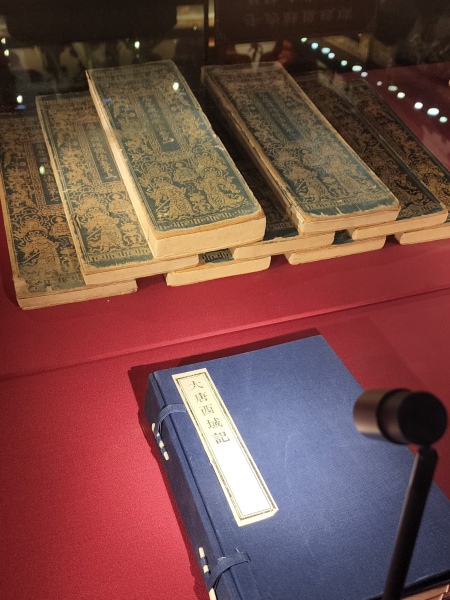 This place filled with centuries of devotion as Xuanzang (唐玄奘) once translated scriptures by lamplight. |
 The huge musical fountain brings life to the square while the Pagoda stands calmly at the background like a guardian from ancient time. |
 “Shunling Walking Lion” at the entrance of the Shaanxi History Museum is the largest ancient stone lion sculpture ever discovered in China. It was discovered at Shunling, the mausoleum of Empress Wu Zetian’s mother, Lady Yang. |
 At the Great Tang Dynasty Night Market, the entire street glowed with lanterns, music. At the center stood a striking statue of Empress Wu Zetian, the only female emperor in Chinese history. Her statue is a reminder of the dynasty’s super power. |
 The first exhibit of the museum is Lantian Man (蓝田人). He is an early form of Homo erectus, discovered in Lantian County, southeast of Xi’an. The fossils, including a skull and jawbone, date back over 1 million years, making them among the oldest human fossils in China. |
 the Tang dynasty pottery figurines of plump, round‑bodied ladies, often called 唐三彩仕女俑. During the Tang dynasty, the empire was wealthy, confident, and cosmopolitan. A fuller figure symbolized health, prosperity, high social status, and aesthetic refinement. |
 Another exhibit displayed Tang paintings of court ladies and governors. Their flowing robes and serene expressions capturing the elegance and multicultural energy of the Tang dynasty. |
 Gilt bronze dragons (赤走金龙) are small in size but incredibly significant in meaning and craftsmanship. Dragons are for the royals. They are made by casting bronze, then applying a thin layer of gold gilding, a technique the Tang dynasty perfected. |
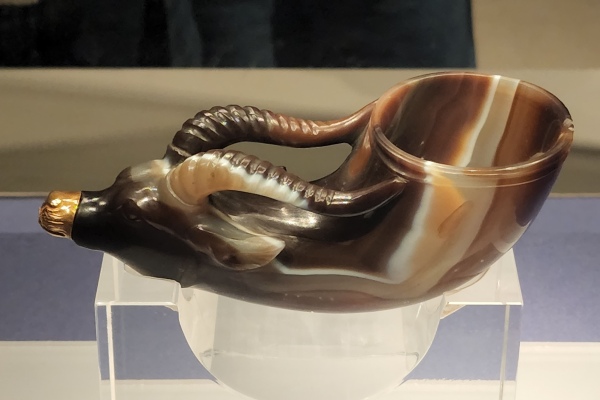 The Persian style ceremonial drinking horn reflects how deeply the Tang and earlier dynasties were connected to cultures along the Silk Road. |
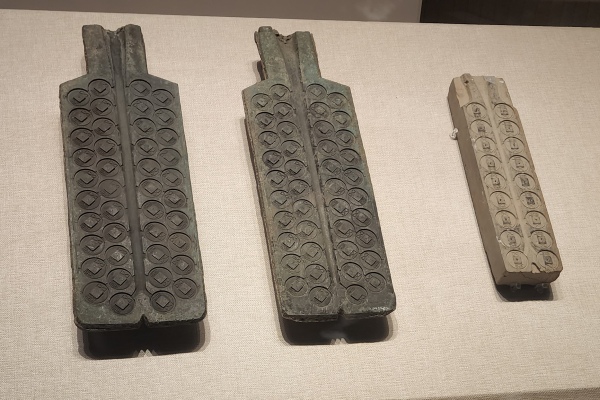 Clay coin‑casting mold (钱范), used in ancient Qin and Han dynasties to mass‑produce bronze coins. These molds were essential tools in early Chinese monetary history. |
 The three‑legged Ding (鼎) is one of the most important ritual objects in all of Chinese history. It was used in ancient China for cooking sacrificial meat, ritual offerings and ancestral ceremonies. Over time, it became a symbol of political power and legitimacy. By the Zhou era, Ding were so important that the number of Ding a noble could own was strictly regulated by rank. |
 This tiny silkworm represents something far greater than its size. The origins of the Silk Road begin with the invention of silk, and therefore with the silkworm itself. More than 5,000 years ago, China domesticated the silkworm, unlocking a material so precious that its demand in Persia, Rome, and Central Asia eventually wove together the vast Silk Road network. |
 A purse bottle (荷包壶) is for carrying liquids, while the horse symbolizes power, speed, and imperial prestige. |
 Tang dynasty gilt‑gold cup decorated with Persian musicians, as they were considered exotic and fashionable at the height of Tang court entertainment. |
 日已觥. This bronze wine vessle (觥) excavated from the Riyi burial site has shown us the craftsmanship of ancient China over 3000 years ago. |
 Guangren Temple (广仁寺) is the only Tibetan Buddhist temple in Shaanxi. The five colors always appear in a fixed order: Blue (sky), White (air), Red (fire), Green (water), and Yellow (earth). Together they represent harmony of the elements. |
 I feel fortunate that a friend from Shandong flew to Xi’an just to meet in person. It was wonderful to catch up and share how our lives have been unfolding. In the end, we simply wish that everyone be happy and free from suffering. |
 We went to Chang’an Da Paidang (长安大排档) to taste traditional signature dishes such as Big Plate Chicken (大盘鸡), Six Little Dishes (小六碟) and to watch intangible cultural performances, including puppet shows and folk dances. |
 The tower contains 21 pieces of Buddha relics or śarīra. It was my second time seeing the real relics, while the first was at Sotheby's. After the Buddha was cremated, the ashes produced tiny pearl‑like crystals. These are considered meeting Buddha himself, symbolizing enlightenment, the Buddha’s wisdom, and the continuation of the Dharma. |
 Royceton had fun playing rock–paper–scissors with the staff. The littl game and interactive moment , full of laughter and friendliness — the kind of simple joy that make a place feel welcoming. |
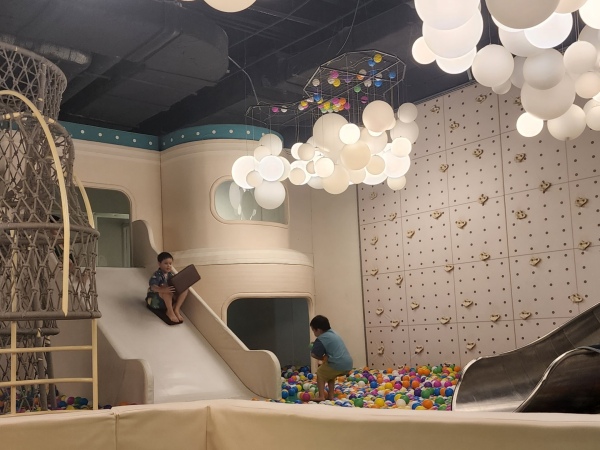 We planned a day to simply rest at a bathhouse, giving ourselves space to slow down and relax. The place was inside a modern mall built on the historic grounds of the East Market. It was 东市 and 西市, whose names eventually formed the everyday word “东西.” |
|
Terracotta Warriors (兵马俑)
This was my second visit to the Terracotta Warriors
Museum, but it felt completely different from the first. Last time, I
joined a tour group; this time, I chose to go on my own. The hotel staff
insisted it was impossible — too far, too complicated, too expensive
without a tour. But I trusted my own research, followed the metro and
taxi route, and it turned out perfectly fine. A small reminder that
sometimes it’s better to trust myself than the “official” advice.
|

 Unlike the grand scale of the First Pit, the Second Pit reveals the army in fragments. Archers, cavalry, infantry, and charioteers emerging from the earth in partially excavated sections. The layout also shows the tactical structure of Qin’s forces. The flanking archers, the forward assault units, and the cavalry formations gives a clearer sense of how this underground army was meant to function. |
 The Third Pit is the smallest, but it carries the greatest sense of authority and mystery. This pit represents the command headquarters of Emperor Qin’s underground army, the nerve center from which orders would have been issued. The layout is compact and deliberate with a ceremonial chariot, a handful of high‑ranking officers, and a guarded central chamber. But the most intriguing detail is what’s not there. The figure believed to be the commander‑in‑chief is missing. The whole Terracotta armies are waiting for their leader to return. |
.jpg) Mount Li (骊山) is where Emperor Qin chose to rest for eternity, and standing there makes the entire Terracotta Warriors experience feel more complete. It’s only a short 15‑minute drive from the museum, but the atmosphere shifts the moment you arrive. From the main gate, it took us about 30 minutes on foot to reach the tall mausoleum marker that indicates the resting place of China's First Emperor. |
 The hill forms a neat square, and it took us about ten minutes to walk along each side. There were hardly any tourists, just long stretches of greenery. The walk itself was quiet and almost meditative. It became a moment of reflection on Emperor Qin’s ambition, his harsh, uncompromising rule that laid the foundations of a unified China, a country that would endure for millennia. |
 There’s no grand entrance or visible tomb, just the knowledge that beneath the earth lies the unopened mausoleum, sealed for over two thousand years, with its rumored rivers of mercury and intricate palace chambers. |
 The Terracotta Army is enormous. Based on excavation and ground‑penetrating surveys, over 8,000 warriors are estimated to exist in total, about 2,000 have been fully excavated and restored. Archaeologists have also found 130+ real-size chariots (mostly collapsed, with bronze parts surviving), 520 horses and 150 cavalry horses. |
 The bronze chariots unearthed near Emperor Qin’s mausoleum. These aren’t full-sized war chariots but half‑scale ceremonial models, crafted with astonishing precision. This “High Chariot”, believed to be used for scouting or leading processions. |
 The Terracotta Army is extremely hierarchical with seven main ranks, each identifiable by posture, clothing, and headgear. They include generals, senior officers, middle-rank officers, lower-rank officers, armored infantry soldiers, unarmored infantry soldiers, and specialized units. |
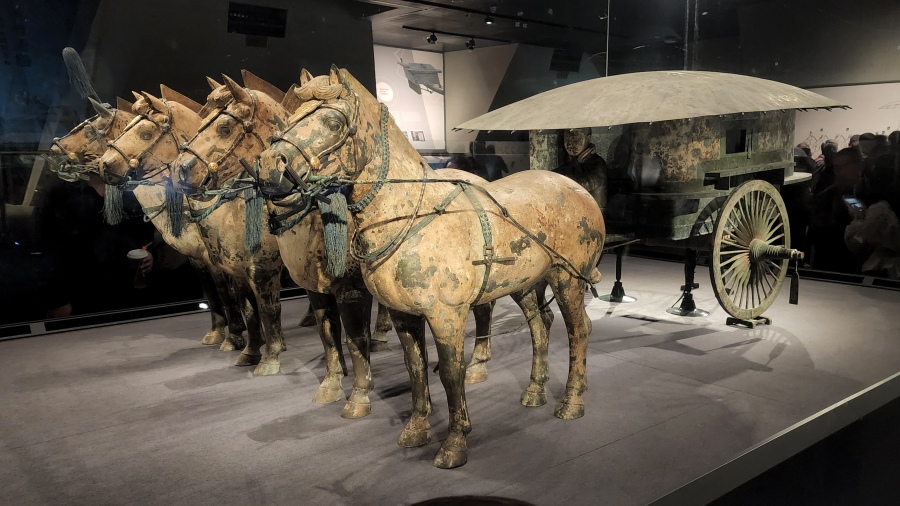 This “Comfortable Chariot”, a more elaborate vehicle likely intended for the emperor’s spirit to travel in the afterlife. Seeing them up close, we realize how advanced Qin craftsmanship was, with the engineering, the joints, the fittings, all created over 2,000 years ago. |
 Archaeologists estimate that over 700,000 workers were involved in making of the terracotta. The process involves clay preparation, separate body parts manufacturing, hollow construction, facial features sculpture, armor and clothing assemble, etc. |
|
Mount Hua (华山) 
This time, I added Mount Hua (or HuaShan) as a destination, a place I had never visited before, but always imagined as a perfect spot for a nature expedition. The mountain rises sharply from the plains of Shaanxi, about 120 km east of Xi’an. As one of China’s Five Great Mountains, Huashan carries is famous for its sheer cliffs, knife‑edge ridges, and Taoist temples perched on ledges that seem almost impossible. |
 We joined a tour that picked us up at 7 a.m. in Xi’an. Instead of climbing from the base, we took cable car up to the West Peak. By the time we stepped out at the top, it was only around 11 a.m., and the mountain was already showing its cliffs, ridges, and endless sky. |
 I have to say, the view was absolutely breathtaking. Standing on one peak and looking across to the adjacent mountain, I found myself staring at a massive cliff wall rising straight into the sky. The scale of it was overwhelming, the kind of sight that makes me stop mid‑step without even realizing it. |
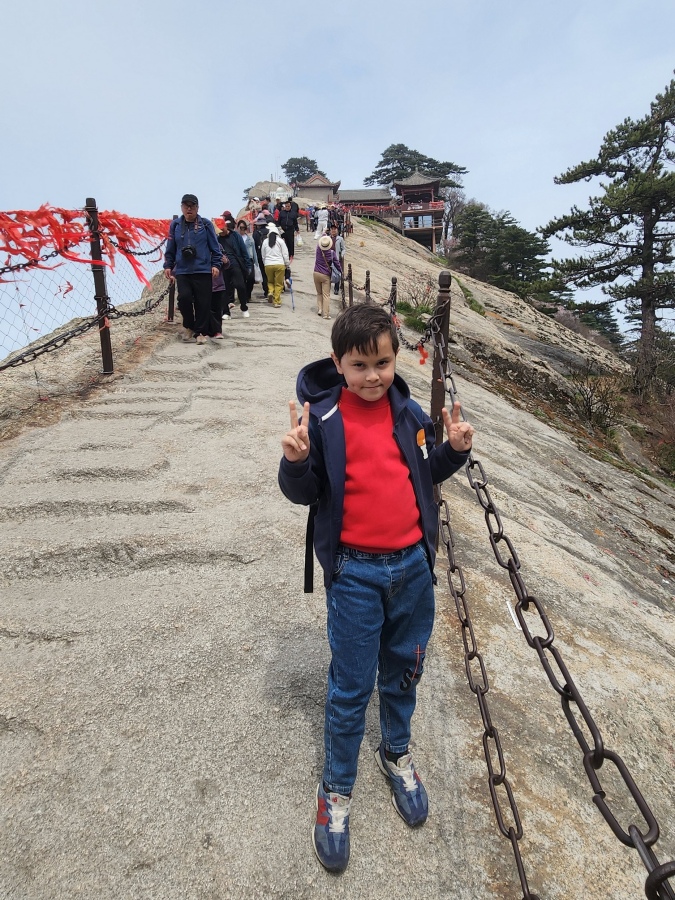 On the West Peak, the path narrows into a long ridge, and for a stretch we had to walk right along the spine of the mountain. On both sides, the cliffs dropped away sharply, and the ridge felt like a natural bridge suspended in the sky. |
 The West Peak is where Mount Hua’s drama becomes real. Looking across to the adjacent mountains, we saw massive cliff wall rising straight up. It’s from the West Peak that we understand why Huashan is called “the Number One Steepest Mountain Under Heaven.” |
 The South Peak is the highest point of Mount Hua, and when we reached it, we were literally above the clouds. The world below disappeared into white mist, and only the sharp ridges and distant peaks rose through the sea of clouds like islands. |
 As Grandpa would be having surgeries, Royceton tied a red ribbon at the peak of South Peak, the highest place on the entire mountain, wishing Grandpa good health and a smooth recovery. |
 Before the cable cars were built, climbing Mount Hua from the base to just one peak could take six hours. The old routes were far more dangerous than anything we walked today. Much of the original climb involved vertical sections, where hikers had to pull themselves up using iron chains bolted into the cliff wall. Some paths were nothing more than narrow ledges carved into the rock. |
 The famous Chinese martial arts novelist JinYong (金镛) popularized the phrase “华山论剑” (Sword Debate on Mount Hua). Through his novels, the idea of martial arts masters gathering on Mount Hua to compete for the title of "Number One Under Heaven" became iconic, turning the mountain into a symbol of heroism, rivalry, and the spirit of the martial world. |
 From the West Peak, we began our journey across the mountain’s spine. We visited the tallest South Peak, then continued toward the East Peak, and eventually passed through the Middle Peak before making our way down to the North Peak, where we took the final cable car back down to the base. By the time we were back to the base, it was already 6 p.m. It's 8:30 p.m. which we were back to hotel. We were so tired. |
 What surprised me was the length and intensity of the experience. In total, we spent six full hours hiking, moving from peak to peak along what was essentially a one‑way mountain road. The paths weren’t difficult, but we the up‑and‑down climbs were exhausting. Also the scenery stopped us in our tracks, pulling us to pause, look, breathe, and take it all in. I am thankful for the experience. |
|
Chengdu Panda Centre (成都熊猫中心) Royceton asked to visit Chengdu. I’m not sure he fully knows what the city is about, but he does know one thing — pandas. So during our one‑day stopover, we spent the day at the panda center, letting him see the animals that make Chengdu famous. |
|
 Here we are at the Chengdu Research Base of Giant Panda Breeding. We only had three hours to explore, so we went early in the morning. The center opens at 7:30 a.m., and we arrived at 8:30. Yet it was already packed. |
 Even on a weekday, there was a traffic jam from the main intersection all the way to the road leading into the research base. We ended up walking about ten minutes just to escape the line of cars. |
 We learned about how pandas live in their natural habitat, and how the base recreates that environment with bamboo forests, shaded paths, and quiet enclosures, mimicking the mountains of Sichuan. |
 Instead of choosing the usual panda doll with a white body and black eyes, Royceton opted for an albino panda. It added a bit of uniqueness to our collection of panda dolls we already have at home. |
 The base also has a red panda habitat. They’re lively and charming, but to my eyes they look more like raccoons, nimble, reddish, and always slipping between the trees. |
 Well, we did see many pandas. At first we were excited, spending 10 minutes just checking the movement of one panda. But after a while we realized they all look alike. |
 People who truly love pandas can probably tell each one apart, but for us, every panda seemed to be doing the same slow, eating and sleepy routine. |
 Eventually we just walked past them without taking any more photos. And that concluded our panda journey at Chengdu. It was a great memory for Royceton. |
|
|
|
|