|
|
|
|
Japan - Central Japan |

|
August 2024
While we are still living in Asia, I plan to take Royceton to explore
the fascinating quintessential destination of Japan. Japan is a
wonderful country, and visiting it when he’s 7 years old will surely
create lasting memories. Instead of heading to Tokyo, the bustling
capital, we’ve chosen to explore the more laid-back, Edo-period cultural
regions of Nagoya (名古屋), Magome (馬籠), Tsumago
(妻籠), Takayama (高山), and Shirakawa (白川乡). |
|
 My third time visiting the Nagoya castle and city area, yet this time is special with family. |
.jpg) My prime tour of this trip is a Nakasendo (中山道) trail, or Samurai Road, from Magome (馬籠) to Tsumago (妻籠). |

|
Hike from Magome to Tsumago (步行中山道,馬籠至妻籠) |

 Magome is the 44th of the 69 post towns in the Nakasendo Trail. So we are staying at this Magome Chaya (馬籠茶屋), an inn that has maintained the Edo Period (1600s) charm. |
 The Magome village is just a short 10-minute uphill walk, brimming with local and souvenir shops, delightful local snacks, and inviting cafes. We're glad to stay here for 2 nights. |
 Royceton had fun setting up the futon bed on tatami mat. We also enjoyed a Japanese-style bathing, completed with a hot tub at over 42°C. |
 Our early morning 7am walk on the village in the traditional Japanese robe. The quiet street and gentle sounds of nature allowed us to fully appreciate the beauty of our surrounding. |
 We began our 8km journey from Magome to Tsumago at 8:30am. The trail is well-marked and suggested to take approximately 2-3 hours to complete. We took 5 hours instead as we were slow to enjoy every moment. Here we were at Magome View Point looking over Mt. Ena (惠那山). |
 Odaki (男瀧), with more water than the Medaki (女瀧). |
 Ring the bell to scare bears away. |
 Stone paved path through the forest. |
 Instead of capturing |
 Pokemon, we captured |
 insects with phone. |
 |
 |
| Along the way, we stopped at Ichikokutochi Tatebachaya (一石栃立场茶屋) to rest and chatted with this friendly uncle using Google Translate. He graciously served us free tea and candies in this charming 250-year-old wooden house. ❤ We also enjoyed some handmade soba near O-Tsumago. | |
 We sampled the locally famous Goheimochi Rice Cake (五平饼). I knew Royceton might not enjoy the flavor, but it was a great opportunity to experience a piece of tradition. |
 Since the soba was freshly made that morning, we felt fortunate to enjoy the last serving of the locally famous dish at this house around 12:50. Yummy. |
 Here we arrived Tsumago around 13:30. This village was preserved in Edo-period architecture, offering a glimpse into Japan's past. |
 Tsumago town was closed on Monday, the day we visited, allowing us to
fully immerse ourselves in its Edo-period charm.
Tsumago town was closed on Monday, the day we visited, allowing us to
fully immerse ourselves in its Edo-period charm. |
 We wandered through the streets without any distractions. |
 Most tourists on the trail were westerns, including families with kids. |
 Then we took the 14:20 bus back to Magome. |
 Enjoying a rice paddy view at Manpuku-an Eishoji (永昌寺), Magome. The bus stop to Nakatsugawa Station (中津川駅) is also in sight. That's the station where we took JR back to Nagoya. |
 Here we had the traditional Japanese dinner at 18:00 at Magome Chaya. |
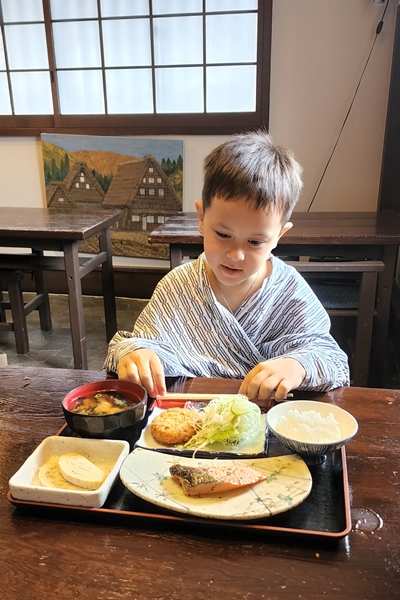 Then breakfast was served at 7:15. |
 A selection of local delicacies was served, including raw horse meat sashimi, freshly made soba, delicate tofu with pork and mushroom, fish, tempura, and milk pudding. Each dish offered a unique taste of the region’s culinary heritage. |
 During this trip, Royceton actively captured Pokémon and battled in local gyms. We left our Arcanine at 一石栃白木改番所跡 for three days, while our Goodra stayed at 十返舍一九狂歌碑 (nowhere in the woods) for a week, returning days after we were back in Hong Kong. |
|
Takayama (高山) |

 We then played in the water beneath the bridge, where the clarity was remarkable, allowing us to spot Koi fish swimming gracefully. |
 We strolled through the commercial area of the traditional district. With the shops closed on Wednesday, we had the streets to ourselves. |
 The old townscape of Hidatakayama Sanmachi Historic District (飛騨高山三町伝統建造物群保存地区). |
 We joined a coach day tour. This is the rest area of our 3 hour journey from Nagoya to Takayama. |
 Rickshaw at Takayama. Where are those hot rickshaw pullers advertised on social media? haha. |
 Sakurayama Hachimangu Shrine Otorii (櫻山八幡宮之鳥居). |
.jpg) The last time I was here was during the Takayama Autumn Festival (秋之高山祭), which was so crowded that I barely had a chance to explore. |
 Purifying our body and soul. I wished for safe and happy journey, so my wish came true. Thankful. |
 Here we tried the famous Hida raw beef sushi. ¥800 for 2 pieces. |
 The residential area of the traditional district. |
 Hida beef preparation in process. |
 At Miyagawa Morning Markets (宮川朝市), we arrived just before the market closed at 11:30. |
 It was the peach season, and we couldn't resist trying a sweet and juicy yellow peach. It was absolutely delicious! |
|
Shirakawa-go (白川乡) |

 Red Sun, Blue Sky, White Cloud, Green Tree, Yellow Earth. Nature is beautiful. |
.jpg) Drawing the focus on the ground. |
 We were playful and splashed holy water at the Hachiman Shrine Shirakawa (白川八幡神社), hoping it would purify our spirits and cleanse our souls. |
 I then wished for the happiness and good health of my family and friends, as that is what dearly matters most. |
 Having watched "My Neighbor Totoro" and "Spirited Away" before this trip, visiting the traditional village felt like stepping into a scene straight out of those films. |
 Aren't these Gassho houses reminiscent of where Mei from "My Neighbor Totoro" lives? Their charming architecture and the tatami interior truly evoke the magic of the film. |
 We stayed only two hours in Shirakawa-go, which is quite a lot for kids for a mere village, while I wanted to stay for days. It was the magic of Pokémon Go that, at critical moments, had kept Royceton energized and engaged, making him eager to explore the area. |
 I revisited the Gassho House where I stayed back in 2016 and was delighted to greet the house lady while she was driving back home. This is life. I never imagined I would visit Shirakawa twice, but here I am again; even bumped into someone we met briefly. |
|
Nagoya (名古屋) |
|
 Our first stop in Nagoya was the Nagoya Castle (名古屋城) and witness the famous decorative golden fish adorning its roof. |
 This was my first visit to the Toyota Museum and I found it incredibly educational. The Circular Looming Machine on display has blown my mind on Toyota's ingenious engineering from that era! |
 I never imagined that Pokémon would remain so popular from 1995 all the way to 2024 and more! There is no generation gap between Royceton and me. |
 It was Saturday after lunch and the Pokémon centre is packed. The line for cashier took 30 minutes. |
 A brief visit to the Nagoya Tower and Oasis 21. |
 The famous Nagoya 20ft tall mannequin -- Nana-chan. |
 The Nagoya Castle Hommaru Palace (本丸御殿). We admired the stunning golden interior. |
 The Osu Kannon Temple (大須観音). We wished for a safe trip. |
 We spent a night at an onsen house for the experience, which also featured a live performance at the restaurant. |
 Atsuta Jingu (热田神宫) - paying visit to the Deity of Water. Hope the water can cleanse the soul and body. |
 Being clothes-free with dozens of other guys made us realize that there really is no difference among us. |
 The other hotels we booked also had onsen facilities. We enjoyed the wash and the hot bath in the early morning and before bed. |
 The Toyota Commemorative Museum of Industry and Technology (豐田産業技術記念館) showcases the history and evolution of Toyota, highlighting its roots in the textile industry before transitioning to automobile manufacturing. I was impressed by its commitment to educating visitors with a presenter at each station. The exhibits further explained key aspects such as the shift away from family management, sales strategies, the just-in-time manufacturing process, the post-war crisis, supply chain development, the re-establishment as a result of the Korean War, and the shifted focus on domestic family vehicles. |
 Toyota began in the 1920s as a textile company, eventually expanding to include machinery and automation. This evolution marked the foundation for Toyoda's second generation to develop the automotive industry. |
 The presenter demonstrated the entire process of cotton production, from pulling cotton seeds and removing dirt to transforming cotton into thread. We learned about the shift to mass production, the use of water wheels for power, and eventually the transition to electricity as a power source. |
 This presenter demonstrated how water, and eventually air, is used to propel thread for weaving fabric. She then demonstrated us the Toyota's 2023 Air Jet Loom Model JAT 910, a multicolor weaving machine. |
 As we transitioned to the automobile pavilion, this presenter demonstrated to only two of us how a rod was heated to 1200°C for 38 seconds and stamped to create auto parts for subsequent manufacturing. |
 This Toyoda Model AA, developed in 1936, was Toyota's first passenger car and marked the company's transition from textile manufacturing to automobile production. |
 The museum admission was ¥1,000 for adults and free for kids. The thorough explanations and demonstrations showcased Toyota and Japan's commitment to education. I am really impressed. |
 |
 |
 |
 We visited the Meglev Museum while it was opened for members only on Tuesday... |
 At least the souvenir shop was open, and Royceton got his Series E7 Shinkansen model. |
 We also had a glimpse of free exhibit of Class Ke 90 Steam Locomotive (1918). |
 Series N700 Shinkansen (2015) with top speed of 330 km/h. |
 Our alternative was to visit the Fuji Antarctic Museum, located on the former icebreaker research boat Fuji (AGB-5001) which was active from 1965-1983. |
 We learned about the geography and history of Antarctica, including the South Pole, the auroras, and the process of ice core drilling to extract chemical components that date back millions of years. |
 The icebreaker was equipped with a helicopter, vehicles, and storage facilities for living necessities, allowing it to support a crew for up to five months in the harsh Antarctic environment. |
 Here is a study of ecosystems found in Antarctic, showcasing the relationships between various species, from krill and fish to seals and penguins. |
 We also explored the icebreaker itself, visiting the engine room, sleeping and living quarters, and the navigating room. Each area offered fascinating insights into the daily life and operations of those who served on the vessel during Antarctic expeditions. |
 Here are some other food we enjoyed in Japan, like having ramen at an izakaya, sushi, creamy Hokkaido milk and ice-cream, etc. We also visited McDonald's thrice for their Happy Meals, which came with Pokémon toys. |
 We opted for local transports like train, bus, and JR. |
 Nagoya's famous fried chicken wings - Sekai no Yamachan (世界の山ちゃん). |
 Then we brought back to Hong Kong |
.jpeg) these fruit souvenir. Juicy and sweet. <3 |
|
Post trip reflection: I am thankful that the trip went well. An earthquake warning was issued on August 8th, two weeks before our journey, and we traveled right between two typhoons, with only our last day experiencing torrential rain. Most importantly, I was able to fulfill my duty to introduce Royceton to aspects of Japanese tradition, culture, nature, and history that will be meaningful in his life. |
|
|
|
|